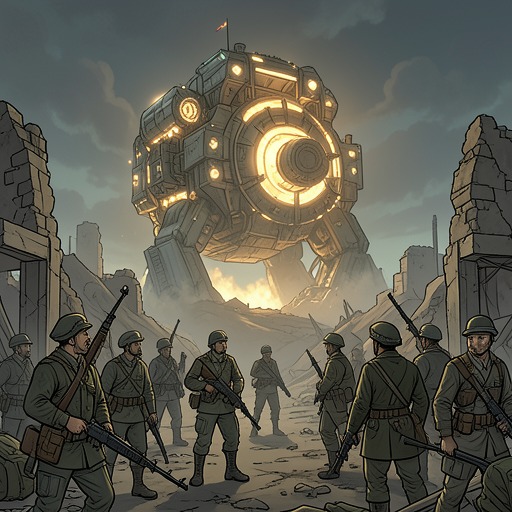
Opening the Infinity Machine Sanctum
Awakening the Angel System: Apocalypse: A LitRPG Progression FantasyOpening the Infinity Machine Sanctum is the turning-point action in which Michael transforms Jack and Sahaqiel’s apparent breakthrough into a carefully prepared ambush. The sealed entrance to the Infinity Machine is opened not by the angel whom Jack trusts, but by a lifeless duplicate created and controlled by Michael. Behind the door waits Adam, the first Awakened and an existential threat, so the opening simultaneously reveals the Black King’s long pursuit, his manipulation of Sahaqiel’s identity, and the scale of the catastrophe he intends to unleash.
Approach to the Sealed Door
Jack and Sahaqiel reach an immense source of mana beyond a passage contaminated by corrupted data. The energy resolves into a large stone door whose smooth surface is covered with intricate carvings. Sahaqiel recognizes an immediate anomaly when she places her hand against the barrier: it has been untouched. The absence of damage or prior interference initially suggests that the pair have arrived before Michael or any other intruder, but that hope collapses when Jack realizes that they are no longer alone.
Michael’s entrance is marked by absence as much as by presence. Jack cannot sense him, and neither can Sahaqiel or Lilith. Yet spatial shimmers disclose that someone is standing behind them. When Jack turns and swings Gram, the blade is caught by a fedora-wearing man in a white suit whose face eerily resembles Jack’s own. Michael identifies himself through provocation, addressing Jack as his son and treating the attack as an impolite greeting. The encounter therefore links the sealed sanctum to a concealed familial and experimental history before the door itself is opened.
The Ambush and the Hidden Key
The first exchange establishes that ordinary resistance cannot succeed. Lightning is caught, bullets stop in midair, and Jack’s electrified claw freezes less than a foot from Michael. The Black King’s control prevents Jack from moving and inhibits the flow of mana on which both captives depend. The apparent absence of pursuing demonspawn and Apostles is then reinterpreted: Michael has been following Jack and Sahaqiel throughout their journey, quietly eliminating the threats that might have reached them first.
Michael’s confrontation with Sahaqiel carries the emotional force of a betrayal. She tells him that the leader she once followed would never have committed the acts he has committed. Michael answers that the leader she knew died when their world ended, while he intends to make a new and supposedly improved one. He asks Sahaqiel to open the door, invoking their shared bond and offering a final appearance of choice. Her lightning attack briefly allows Jack to regain control, but the resistance changes nothing. Michael has already arranged a substitute for the key he cannot obtain from her.
When the translucent light securing the sanctum dies down, the sealed entrance opens. Michael dismisses the importance of the failure and reveals that he has brought his own key. The next chapter makes the revelation explicit: two Sahaqiels stand before Jack. The second appears identical to the angel of freedom and carries an essence that feels unmistakably like hers, yet her eyes contain no life or sentience. She is a husk rather than a person, a manufactured imitation deployed as an instrument. Invisible mana chains then seize Jack and the real Sahaqiel by the neck and drag them into the inner sanctum.
The Inner Sanctum and Michael’s Prize
The chamber beyond the entrance sharply contrasts with the ruined corridor outside. It is lavish and golden, furnished with stately pillars, a throne, skeletal remains, and ancient weapons and armor scattered across the floor. The opulence does not signify safety; it frames Michael’s power as an old, ceremonial dominion built over death. From the throne, he presents the two angels as his saviors, claiming that the end has brought him not one angel but two.
Michael then removes the defensive concealment behind the throne. The wall falls away to expose a chamber filled with pulsating flesh and crystalline figures, an image of living corruption fused with machinery or occult structure. Among the crystals hangs a shackled, tanned man in decrepit trousers. Writhing tentacles and chains suspend him above a pit, while crystals cover his body. Sahaqiel recognizes him immediately, and Jack recognizes him through the angel’s memories: the prisoner is Adam.
Adam is identified as the first Awakened and the first hunter, capable of pursuing magically gifted beings anywhere in the world. Even weakened, he would be fatal to any direct challenger. His unusual hunting pattern intensifies the danger: he pursued angels rather than lesser beings, as though he considered ordinary life beneath him. Michael explains that Jack and Sahaqiel meet the criteria for Adam’s hunt because they are powerful enough to attract his attention. He presents their prospective deaths as a foundation for a newer world, converting sacrifice into a component of his salvation rhetoric.
Awakening the Threat
Michael’s stated objective is not merely to enter the Infinity Machine but to claim what he believes should have belonged to him. He activates the sigils of Gehenna and begins undoing the ancient seals that bind Adam. The chamber shakes, flesh-like tentacles grow around the throne room, and the crystals covering Adam crack and shatter one by one. The physical environment itself becomes part of the opening action: the sanctum is not a passive room but an active mechanism of release.
The pit beneath Adam emits black light and pours out raw magical information. Jack perceives the substance as data, recognizing that the awakening is being powered by a wound in the earth that releases organized mana. Within the whirlpool, he identifies a teleportation function comparable to Ivan’s ability. This detail makes the threat more than a physical awakening; the Infinity Machine’s power is being used as a system for transferring or processing magical information, and Michael has understood enough of that system to exploit it.
Sahaqiel finally states the immediate stakes: if Michael reaches the Infinity Machine, everything is lost. The pair remain bound because Michael assumes that his restraints and suppression of their mana have made resistance impossible. The opening thus ends not with victory but with a narrow, concealed possibility of counteraction, as Jack’s captivity and Michael’s confidence become the conditions for the next reversal.
Political and Thematic Context
The sanctum opening echoes the book’s broader conflict over emergency power. Elsewhere, Selfia defends a purge in which three hundred and sixty-nine lives, possibly more, are being extinguished across the empire, including political opponents, rivals, dissidents, and anyone thought capable of delaying the New Republic. Jack rejects the claim that mass killing was necessary, emphasizing that bystanders, innocents, and even Ada’s unborn child were placed in danger. Michael’s language follows the same structure on a larger scale: he calls the destruction of the old world a necessary correction and treats the death of angels as the foundation of a better future.
That parallel gives the opening its political irony. Selfia claims that violence will secure survival and consolidate power; Jack condemns the concealment and civilian danger in that plan. Michael claims that he will save all mankind while deliberately awakening a hunter who may kill everyone in his path. In both cases, protection becomes the vocabulary through which rulers suspend ordinary limits. The difference is one of scale, not moral grammar.
The action also reverses the apparent logic of rescue and discovery. Jack’s earlier instinct is to evacuate imperiled Theocracy citizens to the Flying City, presenting forced relocation as a choice between accepting protection and dying when demonspawn arrive. Later, when Jack asks what should be done about the High Table’s possible move, the proposed answer is to strike every suspected location. These decisions establish a world in which survival is pursued through preemption, coercion, and totalizing plans. Michael’s opening of the sanctum is the most extreme expression of that pattern: he turns Sahaqiel’s identity into a usable object, converts an ancient prison into a weapon, and calls the resulting catastrophe salvation.
The decisive revelation is therefore not simply that a door has opened. The door discloses that Michael has been present throughout the pursuit, that Sahaqiel can be reproduced without consciousness, and that Adam has been preserved as a weapon against the angels. The sanctum becomes the threshold between a conflict over political control and a confrontation with world-remaking power. By opening it, Michael removes the last barrier separating his ideology from its consequence.